



Download the Basic Sales Pipeline Template
Fill out the form below to grab your free copy of the template.

As a business leader it’s likely you’re well aware of the concept of a sales pipeline. But how important is a sales pipeline to the success of your business? How healthy is your current sales pipeline? And how confident are you in its accuracy?
In this blog post we’ll examine the sales pipeline, why it’s important, and how you can utilise a CRM system to maximise its value to your business.
I also provide a free excel-based basic sales pipeline template that you can download. If you can't wait, you can go grab it here.
Now, let’s start at the very beginning…
Sales opportunities can come from existing clients and customers as well as new ones. Usually, customers can buy more than one product or service from you, and potentially concurrently. With such an array of options it's necessary to define and manage the journey that your prospective clients go through, from their becoming aware of their needs, to them choosing to buy your product or service to satisfy them.
You must also determine the supporting actions that your business needs to take to move prospective customers along this journey. For example: meeting with a prospective client; writing proposals and preparing quotes; following up; etc. This prospect journey – and the various actions that your business needs to take – is your sales process.
Of course, you may instinctively know how to sell, but it might be that you’ve not yet captured and documented the process such that others can consistently follow it.
Your sales pipeline is a visual representation used to value and track your sales opportunities as they progress through the different stages of your sales process. Each sales opportunity is referred to as a ‘deal’.
Deals come into your pipeline through multiple routes. For example:
A deal that is in your sales pipeline can progress through to the next stage; return to a previous stage; or be qualified out entirely. This qualification in or out is referred to as your bid qualification criteria.
Whilst I shan’t go into detail on bid qualification criteria in this article, it’s worth recognising that you may qualify an opportunity out early on – for example, the prospective client is in a market sector that you don’t work with, or there’s a requirement for skills or capacity that you don’t currently have. Or you may qualify out a deal in later stages - for example, you may decide that the deal isn’t sufficiently profitable, or the client geography isn’t the right fit. There can be many reasons for qualifying out a deal. This is why you should have standardised bid qualification criteria.
Your sales pipeline should typically consist of no more than 4-6 stages.
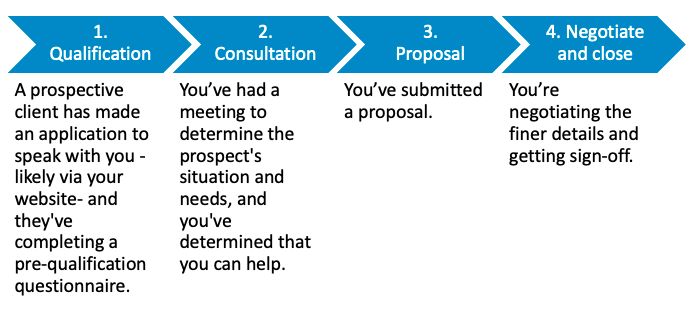
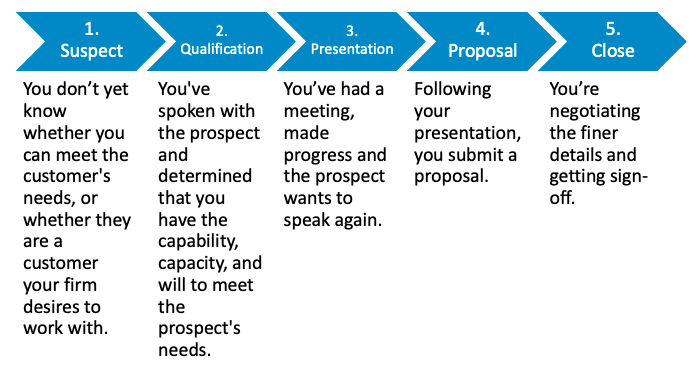
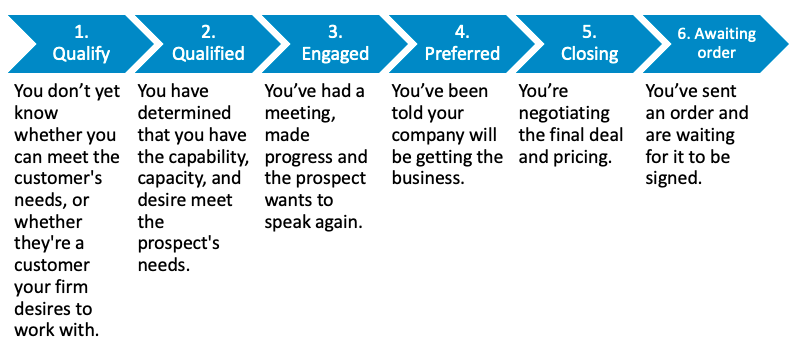
Once a deal is registered in your pipeline, an estimation can be made of its potential value (client spend or investment). Your sales pipeline has a total monetary value which is a sum of all the deals that are in each stage of the pipeline.
Of course, not every deal is expected to be won. As each deal moves through your sales pipeline, it’s likelihood of being won changes. For instance, let’s say that, of all the deals you come across, on average you qualify out 80%. This means that only 20% ‘convert’ to the next stage of your sales pipeline.
Let’s look at an example. If the value of the deals in the first stage of your sales pipeline (qualification) have an estimated value of £1m, and you know that your typical conversion percentage at this stage is 20%, you multiply the value of your deals by your conversion percentage. This gives the value of the pipeline at this stage e.g. £1,000,000 x 20% = £200,000.
Once you have determined your conversion percentages for each stage of your sales pipeline, you can determine your entire sales pipeline value. This is what’s known as a ‘weighted sales pipeline’.
The table below provides an example of a sales pipeline and the different conversion percentages between each stage. It’s typical for the conversion percentages to increase as a deal gets closer to being won.

Once you’ve populated your sales pipeline you’ll have the data required to make a sales value forecast. In the example above, the weighted sales pipeline has a total value of £1.3m and a sales value forecast of £33k.
By stating an expected close date for each deal, you can also plan the potential revenues for your business across the financial year.
Sometimes it may be appropriate for your weighted sales pipeline to consider additional factors beyond simply pipeline stage. For example:
For simplicity of explanation, this article will focus weighting solely on sales pipeline stage.
There’s a lot of data that can be recorded in relation to a deal. The minimum data includes:
There are no hard and fast rules as to what additional data you can record. What’s important is that the data recorded is meaningful. Beware as data can be addictive! Your salespeople won’t thank you for increasing their admin burden by seeking data that is of limited or no value to them.
A CRM system is a great tool to use to manage your sales process. However, I’ve met many prospective clients who are using Post It notes or a whiteboard. As you can imagine, there’s limited data that can be recorded on these. They’re also easily lost/wiped, and they don’t provide for remote access!
Then there are the people who use Excel. Most people start with an Excel spreadsheet. You can obviously record a great deal more data. However, you can’t manage it very well in a spreadsheet, and you’re very limited in how you can interpret and report on that data.
With a Customer Relationship Management (CRM) system in place you have a powerful tool that can positively transform your conversion ratios. For example, with a CRM system in place you can:
In addition to sales pipeline activities, you can integrate your CRM system with other business systems and processes. This opens a wealth of other opportunities to streamline business and increase sales.
Click or tap here to take a look through our case studies to find CRM system integration examples.
For a sales pipeline to be of value, it needs to be healthy. This means it must be kept up to date with accurate data and robustly managed. You can then monitor and measure the individual steps your salespeople take, from initial contact with a prospective client, to qualifying a deal, and progressing through to sales.
With a CRM you can create exception reports aligned to business rules. For example, how many deals are due to close within the next 30, 60, or 90 days. You can also create reports and dynamic interactive dashboards to show data such as:
To maintain a healthy sales pipeline requires both time and effort. The benefits, however, are truly worthwhile as it measures your sales success and is, therefore, an indicator of your company’s wider health.
If you’ve worked with salespeople long enough you know that some have a tendency to be over-optimistic. This is where having a well-defined sales pipeline can help you to have the difficult conversations.
What you must avoid is deals remaining in your pipeline at the same stage for a long time when, in all reality, they have very little chance of progressing. These deals will decrease the accuracy (and honesty!) of your sales pipeline stats.
Often this scenario occurs due to what I call vanity metrics. I go into more detail on this topic in this webinar.
With robust pipeline management, deals are moved swiftly between stages or qualified out. As a result, your sales pipeline is an honest reflection of the health of your business.
In a blog article like this you might expect me to have started by listing the sales pipeline benefits. But, as you’ll have seen, there’s a lot of base knowledge to get out the way first!
If you’ve followed along thus far, you’ll have…
Once you have your sales process and a sales pipeline defined, you can start to proactively manage and optimise your organisation’s sales process. For example, let’s say you’ve got two deals in the pipeline this month, yet you’d normally expect to see five to hit your targets. Your sales pipeline instantly makes you aware that you’ve got to find three new opportunities to maintain a consistent level of sales and hit targets.
Your sales pipeline will also make you aware of positive changes in your deals. For example, if the average size of your deals increases, or a conversion percentage improves.
Of course, all the above can be accomplished much simpler and easier if you utilise a CRM system to help manage the process.
Now, go and review your sales process and sales pipeline. Are you heading in the right direction to achieve your sales targets this year?
As I've discussed in this article, the best place to create and maintain a robust pipeline is in a CRM system. However, if you want to have a play around with the concept first, or simply move away from those manual Post-It note and Whiteboard processes in the short-term, you can download our free Basic Sales Pipeline Template below. It's created in Microsoft Excel.
If you're still managing your sales opportunities in the heads of people, via Post-It notes, on a whiteboard, or in a spreadsheet...
OR...
you've got a CRM system in place, but you haven't realised the promised benefits...
...then it's time to talk to an expert!
Click the button below to schedule a complimentary consultation with one of our team.
